Otawalle medicine
The Deer KingOtawalle medicine is a medical tradition built around investigating disease and pursuing treatment even when a patient has been pronounced incurable. In the story, its commitment to finding causes and possible remedies sets it against the Pure Heart Creed, whose priest-doctors regard the acceptance of death as part of their religious duty. The divide shapes not only clinical decisions but relations between physicians, rulers, and institutions: a cure can demonstrate Otawalle skill, provoke political resistance, and force a society to confront what it believes medicine is for.
Principles and Practice
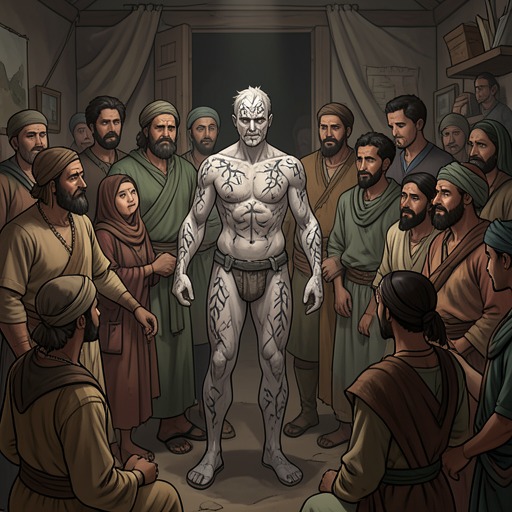
Otawalle physicians seek to identify what causes illness and how it might be prevented or treated. The contrast becomes visible when Hohsalle examines bodies from the salt mine: bite marks and a rash, rather than an assumed mistake involving poisonous food, point toward an infectious disease. He explains that black wolf fever can be transmitted by wolves and wild mountain dogs called ossam, and can also be carried by fleas or ticks that have bitten infected animals or people. The bodies are evidence to investigate, not simply a reason to accept that nothing more can be done.
The investigation has practical aims. Hohsalle and Milalle describe the bodies as possible sources of several kinds of medical knowledge: the disease agents might be identified and weakened to produce a less potent preparation, studied to find substances that suppress or eliminate the illness, or compared with substances formed in patients’ bodies that might help them resist it. These are proposed avenues of research, not a claim that a cure has already been found. Their significance lies in turning observation of disease into questions that can guide prevention and treatment.
Hohsalle’s explanation of the weakened preparation makes this preventive principle concrete. The body, he tells Yotalu, contains defenders with different tasks; they must learn to recognize a particular disease agent. Introducing a weakened agent can teach them what to fight, although the treatment itself places some burden on the body. Hohsalle credits his grandfather, Limuelle, with discovering why some diseases are contracted only once and with devising the idea of introducing weakened agents. Hohsalle then built on that work by developing an injectable medicine. The method is neither presented as risk-free nor as a guaranteed cure: Hohsalle reports twelve patients without symptoms after treatment, while stressing that experience with the method remains limited.
Conflict with the Pure Heart Creed
The theological disagreement is institutional as well as medical. Zolian physicians are revered as “the fingers of the god,” and medicine is expected to conform to divine teaching. When priest-doctors declare a condition incurable, accepted practice is to leave the patient to the god and use only medicines that help the patient die in peace. Otawalle treatment challenges that boundary by treating a diagnosis of incurability as a reason to keep investigating, not as a final ruling on what medicine may attempt.
The disagreement has already altered relations at the highest levels. When Emperor Natalu’s wife fell gravely ill, he summoned Limuelle and Hohsalle despite advisers’ objections that Otawalle remedies were heretical. They cured her. Natalu asked them to remain as palace physicians and teach the priest-doctors, but the palace doctors reacted angrily, and a clash between the association of priest-doctors and the emperor followed. Limuelle and Hohsalle declined the offer, yet the episode publicized the success of Otawalle medicine. A decade later, it remained officially branded heresy, even as nobles quietly sought Otawalle physicians after being told that their illnesses were incurable.
The conflict becomes especially clear in Hohsalle’s exchange with Lona about preventing rabies. Lona says he would refuse a preventive medicine, because he believes that crossing the divinely established boundaries between humans, dogs, and insects would produce chaos. His account defines the priest-doctor’s duty differently from Hohsalle’s: the goal is not simply to save lives or lengthen them, but to save the human soul and help people live with peace of mind in the bodies they have been given. Hohsalle recognizes that this is not just political resistance to his authority. Their medical traditions diverge at the level of their first principles, leaving them without common ground on whether preventing a disease is itself a proper act of healing.
Research, Risk, and Cooperation
During the black wolf fever investigation, Otawalle researchers organize the search for treatment along three lines. One team works on a weakened version of the infectious agent to strengthen resistance; another tests lichens and other substances for an anti-mittsual drug; a third seeks to make a serum from substances produced by infected patients’ bodies. The serum is available only in small quantities, and promising substances have so far been used on rats, not people. Hohsalle is explicit that no cure has yet been found. The three approaches express a research program under uncertainty, not a finished medical solution.
That uncertainty also defines the choices surrounding preventive treatment. In discussing an experimental rabies medicine with Governor Ohan and Utalu, Hohsalle explains that it must be injected several times, with days between injections, and acknowledges that it carries some risk. He sets that risk against the certain fatal outcome once rabies appears, and reports that twelve people treated with his method have survived without symptoms after being bitten by a dog that died of rabies. His evidence is encouraging but limited; Utalu questions whether those people were infected in the first place. Hohsalle does not erase the uncertainty to secure agreement. Instead, he makes the limits of the evidence part of the medical decision.
The need for cooperation follows from the same limits. When black wolf fever emerges in territory where it is native, Hohsalle plans to notify the Sacred Territory and request advice, but first waits for Yotalu’s father’s permission. Yotalu welcomes Otawalle support, explaining that his father, Governor Ohan, and his brother, Utalu, take the danger seriously and want him to follow Hohsalle’s instructions. Their response makes possible a working relationship across political and medical boundaries. It also shows how the sharing of knowledge depends on permission and trust: news of the disease could cause panic and expose the realm to invasion, yet withholding expertise would leave the authorities without the knowledge they need.
Competing Accounts of Illness
Mana, a priest-doctor, clarifies the difference between studying a disease agent and treating what can be observed in a patient. Hohsalle offers to show him the tiny organisms that cause disease, but Mana declines. In his view, priest-doctors need not identify the particular cause: the patient’s body already reveals the problem from the body’s perspective, and treatment should remove the obstacles associated with defilement. He chooses to attend to the human form and help the sick live good lives. His position is not simply a rejection of care; it is a distinct account of what knowledge is necessary and what a physician should seek to accomplish.
Limuelle sees both the attraction and the cost of that account. He understands that a creed offering a final answer can appeal to people, but argues that progress requires investigating the separate aspects of a confused world. He describes Pure Heart Creed medicine as a chain on Otawalle medicine, constraining it through a framework that accepts death from disease at the outset. For Limuelle, refusing to give up is an ethical as well as investigative commitment: a contagious illness is not only the patient’s problem, since surrendering hope may allow it to spread. He urges Hohsalle to create further opportunities to work with Mana and other interested priest-doctors; bringing them alongside Otawalle physicians could loosen institutional constraints and widen access to funds, people, and medical knowledge.
Survival and Significance
Otawalle medicine carries a wider idea of survival that exceeds the fate of an individual patient. Milalle describes a tradition in which creatures that consume others grow stronger, while the consumed do not simply cease to exist: they become part of the body that consumes them. She connects this image to the Otawalle saying “Live by helping other nations live.” Makokan sees in it a way to understand how the Ancient Kingdom of Otawalle could be destroyed while its people survived by being absorbed into another kingdom. The principle links medicine’s effort to preserve life with a culture’s way of enduring political loss—not by claiming that nothing has been lost, but by making continued life possible through relation to others.
Across the medical debates, Otawalle practice is defined by questions that the Pure Heart Creed’s doctrine tends to close: what causes a disease, whether it can be prevented, and what evidence is sufficient to risk a treatment. Its limits remain real—research is slow, human evidence may be scarce, and experimental methods may harm as well as help. But its refusal to treat those limits as a divine final answer keeps inquiry open. The resulting conflict is therefore also a conflict over who may ask, investigate, and decide when a life can still be helped.